
Most roof problems are invisible from the ground, and most of the expensive ones start somewhere you would never think to look: inside the attic, under the flashing, at a seam that has lifted half a centimetre. By the time a roof problem is obvious from the driveway, it has usually been developing for a year or more, and the cheap fix has often already passed. That is the whole point of a roof inspection. It is not a sales gimmick and it is not a formality; it is the one reliable way to know what your roof is actually doing before a small problem becomes a deck replacement.
Here is the short version. A proper roof inspection checks four things, the exterior surface, the interior and attic, the ventilation, and the drainage, and ends with a written report that tells you whether your roof needs nothing, a repair, or a replacement, and roughly how long it has left. You need one after a storm, before buying or selling a home, when the roof is getting on in years, or when a leak keeps coming back. In Markham and across the GTA, that inspection is free, and it is the honest first step before any roofing decision, which is exactly why it is the place to start.
What a professional roof inspection covers
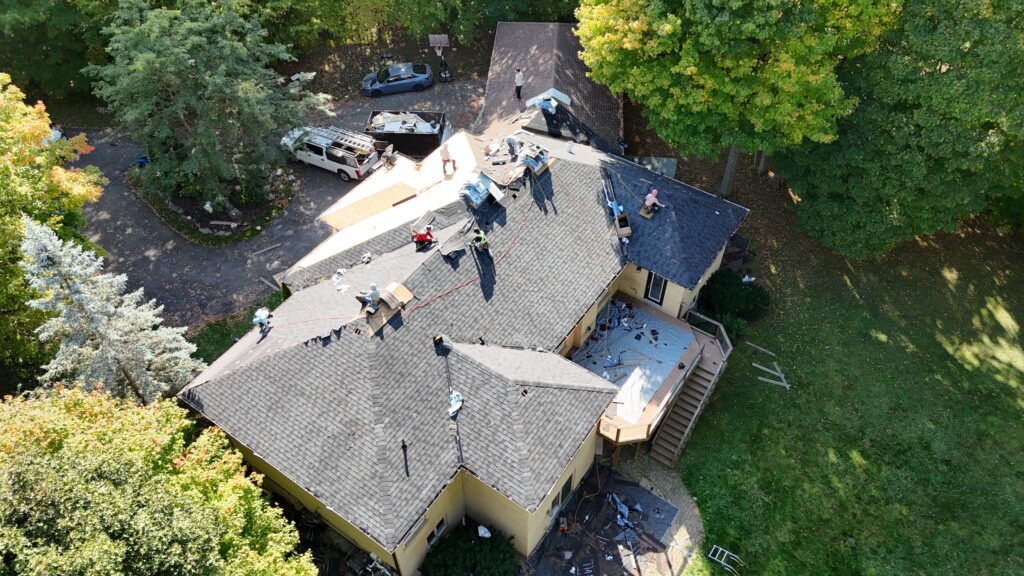
A real inspection is not someone glancing up from the lawn. It is a systematic check of the whole roof system, inside and out, because a roof is an assembly and it fails at the connections between its parts. The specific checks shift with the roof: on a sloped shingle roof the focus is the field, the flashing, and the granule wear; on a flat or low-slope section it is the membrane seams, the ponding, and the drainage. A good inspection knows the difference and looks for the right failures on the right roof.
Area inspected | What we are looking for |
|---|---|
Exterior surface | Shingle condition (curling, cracking, granule loss), missing or lifted shingles, blistering on flat sections, and overall wear against the roof’s age |
Flashing and penetrations | The flashing around chimneys, vents, skylights, and walls, where most leaks actually start, plus the condition of the seals and boots |
Eaves, valleys, and edges | The eaves and valleys where water concentrates, the edge metal, and any sign of ice-dam damage from the previous winter |
Drainage | How the roof sheds water, ponding on flat sections, the drains and scuppers, and whether anything is holding water it should not |
Interior and attic | The underside of the deck for staining, daylight, or rot, the insulation for moisture, and any leak tracking that does not show from outside |
Ventilation | The balance of soffit intake and ridge or roof exhaust, because a poorly vented attic is what quietly ages a roof and voids many manufacturer warranties |
The part most homeowners do not expect is the attic. A lot of a roof’s real condition is only visible from underneath, where staining on the deck, damp insulation, or a lack of airflow tells you more about how long the roof will last than the shingles do. An inspection that never goes into the attic has only seen half the roof.
When you need a roof inspection
There are four moments when an inspection earns its keep, and a couple of habits that prevent surprises.
After a storm. A wind or hail event can lift or bruise shingles and dent flashing in ways that are hard to see from the ground but easy to document on the roof. If you may have a storm-damage insurance claim, an inspection while the evidence is fresh is what makes or breaks it.
Before buying or selling a home. A roof is one of the most expensive systems in a house, and “looks fine” is not a condition report. A pre-purchase inspection tells a buyer what they are actually taking on, and for a seller it removes the roof as a negotiating weapon.
When the roof is getting older. Once a roof is into the back half of its expected life, an inspection turns “I think it has a few years left” into an actual answer, so you can plan a replacement rather than be forced into one mid-winter.
When a leak keeps coming back. A leak that returns after a patch is the roof telling you the patch was treating a symptom. An inspection finds the cause, which is often nowhere near where the water shows up inside.
As a habit, an inspection every couple of years, and after any major storm, catches the small problems while they are still small. That cadence is far cheaper than the alternative.
What the inspection report tells you
The deliverable of an inspection is not a verbal “yeah, it looks alright.” It is a written report, and a good one does three things.
It tells you the roof’s condition in plain terms, backed by photographs of what was found, so you are not taking anyone’s word for it. It gives you a verdict: the roof needs nothing yet, it needs a specific repair, or it has reached the point where replacement is the honest call. And it gives you a rough sense of remaining life, so you can plan rather than react.
That repair-versus-replace verdict is the most valuable line in the report. A localized problem on a roof with years left is a repair. The same problem on a roof near the end of its life is usually the moment to plan the replacement, because money spent on a roof that is going to need replacing soon is money spent twice. A proper inspection is the only honest way to know which of the two you are looking at, and the report is what lets you make that call with evidence instead of a guess.
Roof inspection versus a free estimate: what is the difference?
This trips up a lot of homeowners, so it is worth being clear. A free estimate and a roof inspection are not the same thing, even when both are free.
An estimate exists to price a job you have already decided to do. It answers “what will it cost to replace or repair this roof,” and it assumes the decision is made. An inspection comes earlier and answers a different question: “what does my roof actually need.” It is diagnostic, not transactional. The output of an inspection is a condition report and a recommendation, which might be a repair, might be a replacement, and might be “nothing for now, see you in two years.”
The output you keep is a professional diagnostic report: a photographed, written baseline of your roof’s health that is yours whether or not you ever hire us. That is the difference between an honest inspection and a free inspection used as a sales lever, and it is the version worth booking. As a GAF Certified contractor based in Markham and serving the GTA, YS Roofing leads with the inspection precisely because the inspection is what protects you from being sold a replacement you did not need, or from patching a roof that should be replaced. What it finds, not what we want to sell, drives the recommendation.
What happens after the inspection
You get the written report, with photographs and a plain-language verdict: no action, a repair, or a replacement, plus a rough sense of remaining life.
If it is nothing yet, we tell you that and what to watch for, with no pressure and no manufactured urgency.
If it is a repair, you get a clear scope for the one thing that needs doing.
If it is a replacement, you get a clear written scope you can compare against any other quote, with the ventilation and the code-required protection built in.
FAQ
What is included in a roof inspection?
A professional inspection covers the exterior surface (shingles, flashing, penetrations, valleys, and edges), the drainage and any flat sections, the interior and attic (deck, insulation, and leak tracking), and the ventilation. It ends with a written report, usually with photographs, that states the roof’s condition and whether it needs nothing, a repair, or a replacement. An inspection that skips the attic and the ventilation has only seen part of the roof.
How often should you have your roof inspected?
Every couple of years is a sensible cadence for most homes, plus a check after any major wind or hail storm. Older roofs, roofs that have had recurring problems, and flat roofs benefit from more frequent inspection, because catching a small issue early is far cheaper than repairing the water damage it causes if it is left.
Do I need a roof inspection before buying a house?
It is one of the smartest pre-purchase checks you can make, because the roof is among the costliest systems in a home and a general home inspection often only glances at it. A dedicated roof inspection tells you the roof’s real condition and remaining life, so you know whether you are buying years of peace of mind or a replacement you will be paying for soon.
How long does a roof inspection take?
A typical residential roof inspection takes under an hour for the on-site work, longer for a large or complex roof, or one with extensive flat sections and drainage to assess. The written report follows, so you have documentation rather than just a conversation.
Book your roof inspection: what happens next
Book a free roof inspection. We assess the exterior, the flashing and penetrations, the drainage, the attic, and the ventilation, across Markham and the GTA, often on a fast same-area schedule.
You get a written report with photographs and a plain verdict: no action, a repair, or a replacement, with a rough sense of how much life the roof has left.
There is no pressure and no manufactured urgency. If the roof is fine, we tell you so.
If work is needed, you get a clear written scope you can act on or compare, whenever you are ready.
Whatever roofing question brought you here, this is the step that answers it with evidence: book your roof inspection. If a storm is the reason, see how an inspection supports a roof insurance claim; if it is a flat roof, read the signs your flat roof needs replacing; and if replacement is on the table, here is the full picture on roof replacement across the GTA.
YS Roofing
Trusted roofing services provider
YS Roofing is a trusted, GAF Certified™ Residential Roofing Contractor with over 15 years of industry experience serving the Greater Toronto Area. Specializing in comprehensive roof replacements, expert repairs, and structural protection, the company is built on a foundation of premium craftsmanship, high-quality materials, and exceptional customer service.