
If you are holding two quotes for two different shingles and trying to break the tie, here is the order to do it in. Compare the class first, architectural rather than three-tab. Then compare the nailing zone, because a wider reinforced zone is the single spec that most reduces the chance of a bad install. Then the wind rating, then algae resistance, then impact if your insurer cares. Then stop looking at the spec sheet and ask both contractors what they intend to do about your attic ventilation and your eave protection, because those two decide more about how long the roof lasts than anything printed on the wrapper.
This guide assumes you have already decided on asphalt shingles rather than metal or a flat membrane. If you have not, start with choosing the right roof type for GTA homes.
Why brand rankings are the wrong place to start
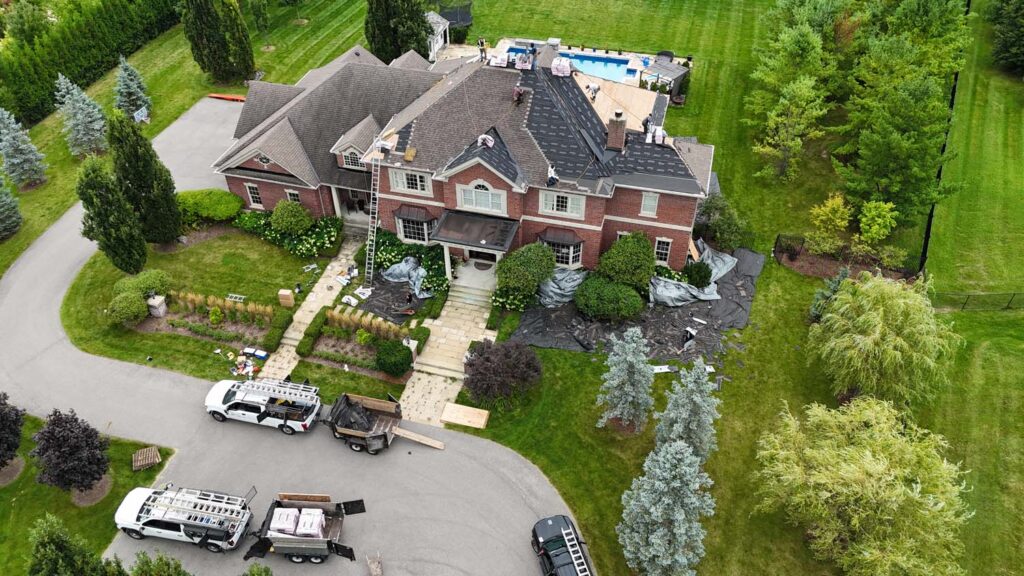
The major North American shingle manufacturers all produce a comparable range: an entry three-tab, a mainstream architectural laminate, and one or more premium or designer lines. Within a given tier they compete closely enough that the choice between two reputable brands is rarely the thing that decides how your roof performs.
What decides it is the tier you buy within that range, whether the installation meets the manufacturer’s requirements, and whether your attic lets the roof breathe. Those three account for most of the gap between a roof that reaches the top of its range and one that fails early.
There is also a practical reason to hold brand loosely. Contractors carry what they are certified and supplied to install, and a crew fluent in one manufacturer’s system will usually give you a better roof in that system than a mediocre install in your preferred brand. Choose the contractor and the tier. Let the brand follow.
The five specifications worth reading
1. Shingle class: three-tab versus architectural
This is the largest single decision on the spec sheet.
Three-tab shingles are a single flat layer with cutouts, lighter and thinner. They are still manufactured and still sold, and they are rarely the right answer on a GTA primary residence. They fail early in freeze-thaw, which is why the usual advice here is to step up to architectural rather than to save on the shingle. If a quote in front of you is built on three-tab, that is the first thing to question about it.
Architectural, also called laminate or dimensional, shingles bond two layers together. They are heavier, more dimensionally stable, handle wind better, and are the working standard on GTA homes for good reason.
Premium and designer lines go heavier again and often carry a different look. Whether that earns the step up depends on your exposure and how long you plan to stay.
2. The nailing zone
This is the least glamorous specification on the sheet and the one most worth hunting for.
Better architectural and premium lines carry a reinforced, wider nailing strip, which widens the target the installer has to hit. That matters because high nailing, a fastener driven above the correct zone, is one of the most common installation faults, and it is invisible once the next course covers it. It shows up years later as a shingle that blew off in a windstorm and got recorded as wind damage rather than as the install error it was.
A wider zone does not make a careless crew careful. It makes an ordinary crew harder to trip up. If you are comparing two architectural shingles and want one specification to weigh, weigh this one. It usually sits on the manufacturer’s data sheet rather than on the quote, so you may have to ask for it.
3. Wind rating
Shingles carry a manufacturer wind rating, and it is not an abstract number in a region that gets Great Lakes wind events and the tail of the occasional tropical system. The rating is also conditional on the shingle being installed the way the manufacturer specifies, which typically means a defined nailing pattern and correct starter courses at the eaves and rakes. A shingle rated for high wind but nailed high, or with too few fasteners, does not perform to its rating. That is one of the quiet ways an install failure later gets recorded as a wind failure.
Ask what the rating is and ask what installation conditions it depends on. The second question tells you whether the contractor knows.
4. Algae resistance
Those dark streaks running down a north-facing slope are algae, not dirt and not decay. They are cosmetic rather than structural, but in the GTA’s humidity they are common enough that most quality shingles now include algae-resistant granules. Two things worth knowing. The protection is not permanent: those granules deplete over the life of the roof, so streaking can return on an older roof that started out resistant. And the warranty on that resistance is usually shorter than the warranty on the shingle itself, so read the two separately. Check the line you are quoted carries it, particularly for slopes that sit in shade.
5. Impact rating
Impact resistance is a separate rated property covering how a shingle handles hail. Ontario is not the hail belt, though the GTA does see hail. It sits last on this list deliberately. Whether an impact-rated shingle earns its step up on your roof is a question worth putting to your own insurer, because the answer depends on your policy rather than on a general rule, and we would rather you asked them than took our word for it.

Breaking a tie between two quotes
The most common real situation is not choosing a brand from scratch. It is two quotes, two different shingles, both architectural, and no idea what separates them. Work down this order and stop as soon as one option clearly wins.
- Class. If one is three-tab and one is architectural, the comparison is over. Take the architectural.
- Nailing zone. Compare the width of the reinforced nailing strip. Wider is more forgiving of the most common install error, and it is the spec that quietly protects you from a mediocre crew.
- Wind rating, and what it depends on. A higher rating only counts if the quote also commits to the nailing pattern and starter courses the rating assumes.
- Algae resistance, and separately the length of the algae warranty, which is usually shorter than the shingle warranty.
- Impact rating, last, and only if your insurer has told you it changes anything for your policy.
If both shingles come out level on all five, they are level, and the decision moves off the spec sheet entirely. At that point you are choosing between two contractors rather than two products, and the questions that matter are what each one will do about your attic ventilation, what eave and valley protection each is including, and which warranty each can actually register on your roof. See how to choose a roofing contractor in the GTA.
What matters more than any of them, in this climate
Two things outrank the whole spec sheet on an Ontario roof.
Attic ventilation. A shingle is cooled from underneath by the attic below it. When the soffit intake and the ridge or roof exhaust are unbalanced, the deck stays warm and damp, the shingles cook from below, and the roof ages faster than the wrapper suggests. Inadequate ventilation is also one of the most common conditions that voids or restricts a manufacturer warranty, which means it can cost you the shingle and the coverage in one go.
Eave and valley protection. Ice damming at the eaves is a defining feature of an Ontario winter, and these two defences are not parallel. They sit in sequence. Prevention happens inside the house and the attic: ceiling insulation and air sealing stop household heat reaching the deck, and ventilation carries away what gets through. Together they keep the deck cold, which is what stops snow melting and refreezing at the eaves in the first place. Ventilation alone cannot offset a poorly insulated, leaky ceiling. The self-adhered membrane along the eaves and in the valleys is the mitigation, the layer that keeps water off the deck on the days the dam forms anyway. A roof with good membrane and starved ventilation will still get ice dams every winter. It will just take longer to rot. No shingle, at any tier, is designed to be the last line of defence against water travelling uphill.
If the scope forces a choice between a premium shingle on a compromised assembly and a solid architectural shingle on a properly ventilated, properly protected one, the second roof outlasts the first. That is not a soft recommendation. It is the pattern we see on GTA roofs every season. See how GTA freeze-thaw cycles shorten a roof’s life.
Matching the shingle to the house
Not every GTA roof wants the same answer.
Steep, cut-up subdivision roofs in Markham, Richmond Hill, and Whitby have a lot of visible surface, so the dimensional look of an architectural or designer shingle actually reads from the street, and the extra weight sits comfortably on a modern truss roof.
Simple gables on postwar bungalows and back-splits across North York, East York, and Etobicoke get less visual return from a designer line. The money usually does more good in the ventilation correction those attics frequently need.
Century homes in the older Toronto neighbourhoods often carry plank decking that has to be sheeted over before modern shingles can be installed to the manufacturer’s requirements, and that work has to be in the plan before the shingle choice matters at all.
Any low-slope or flat section, common on rear additions, is not a shingle question at all. Standard asphalt shingles need a minimum slope to shed water, and below it the answer is a membrane. See flat roof replacement in the GTA.
Frequently asked questions
What are the best roof shingles for a Canadian climate?
For most Ontario homes, an architectural laminate shingle with a solid wind rating and algae-resistant granules, installed over correct eave and valley protection on a properly ventilated attic. The step from three-tab to architectural delivers most of the available improvement. Beyond that, premium lines buy appearance, weight, and sometimes enhanced impact or wind performance rather than a fundamentally different roof.
Are architectural shingles worth the extra over three-tab?
In this climate, generally yes. They are heavier, more dimensionally stable, handle wind better, and reach a longer service range. They are also the market standard here, which means the trades and the supply are geared to them. Three-tab is the exception rather than the default on GTA primary residences now.
How long do asphalt shingles last in Ontario?
Basic three-tab typically reaches 15 to 20 years and architectural shingles 25 to 30, with Ontario roofs tending toward the lower half of each range because of freeze-thaw and ventilation quality. See how long a roof lasts in Ontario.
Two quotes, two brands, both architectural. Which do I take?
Work the five specifications in order and stop when one clearly wins: class, nailing zone, wind rating, algae resistance, then impact. If they come out level, they are level, and the decision is no longer about the shingle. At that point you are choosing between two contractors.
What causes the black streaks on my roof?
Algae. It is cosmetic rather than structural, it favours shaded and north-facing slopes, and it is common in the GTA’s humidity. Most quality shingle lines now include algae-resistant granules, which is worth confirming on the line you are quoted rather than assuming.
Do I need impact-resistant shingles in Ontario?
Not as a default. Ontario is not the hail belt, though the GTA does see hail. If you are weighing the step up, put the question to your own insurer rather than deciding on general principle, because the answer turns on your policy and your exposure rather than on a rule of thumb
What happens next
- Book a free roof inspection. The exterior, the flashing, the drainage, and the attic are all assessed, because the ventilation decides how long any shingle you choose will actually last.
- Receive a written verdict with photographs, including what the attic and the deck look like, which is what determines whether the shingle choice is the main decision or a secondary one.
- If replacement is the answer, we go through the shingle tiers on your roof specifically, what each would mean for its exposure and its slopes, and exactly which manufacturer-backed coverage can be registered on the work.
- Nothing is recommended before the roof has been seen. If the answer is that a mid-range shingle and a ventilation correction serves you better than a premium line, that is what we will say.
Free estimates and financing options are available once you know what the roof actually needs. For the full decision sequence, see roof replacement in the GTA: the complete homeowner guide.
Shingle roofing and roof replacement across the GTA, Durham Region, and Peterborough: shingle roofing in Toronto · North York · Scarborough · Etobicoke · Richmond Hill · Pickering · Ajax · Whitby · Oshawa · Peterborough · Markham and residential roofing